On 14th January 2026, GENCI members, as part of the Digital Science Lab, participated in the XIII National Conference BIFI 2026, hosted by the Institute for Bio-computation and Physics of Complex Systems of the University of Zaragoza. This conference provides a unique occasion for participants to share their latest findings across the Institute’s diverse research fields: from Physics and Computation to Biophysics, Biochemistry, and Cell and Molecular Biology.
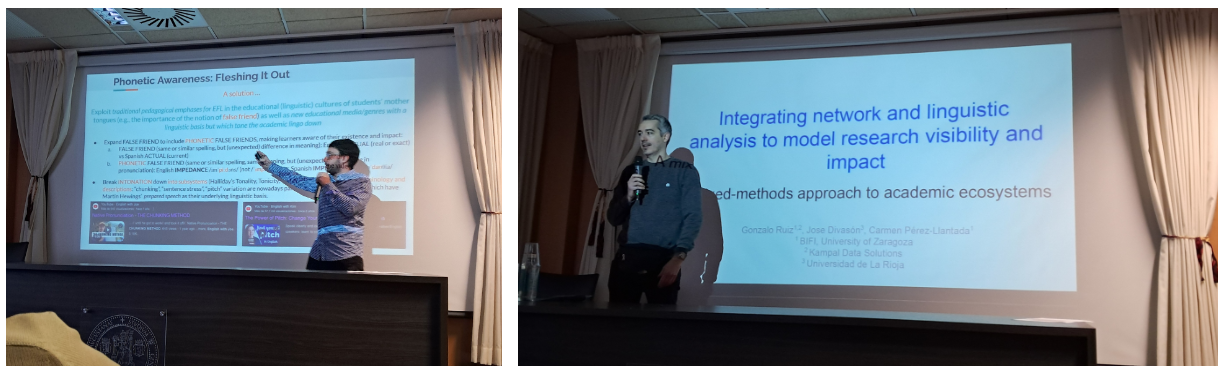
Our talks dealt with authorship networks, corpus linguistics, digital genres pedagogy and training, and collaborative interdisciplinarity. You can read the presentation abstracts below:
Integrating network and linguist analysis to model research visibility and impact: A mixed-methods approach to academic ecosystems (Authors: Gonzalo Ruiz, Jose Divasón, Carmen Pérez-Llantada)
In our current research we have used network analysis to describe the academic ecosystems of four leading EU researchers. We have also supplemented the network analysis results with a textual analysis of the language used in the titles in order to bridge the social and the linguistic dimensions of research productivity and impact in today’s increasingly competitive research world. In this presentation we share some interdisciplinary methodological reflections, highlighting the value of establishing synergies between network and text-linguistic perspectives are mutually beneficial. Specifically, in this presentation we explain how we have used network analysis to map social dimensions (i.e., collaboration structure) and linguistic data mining to analyze discursive dimensions (i.e., communicative effectiveness) influencing research productivity and visibility. The convergence of these quantitative and qualitative methodologies provides a more nuanced interpretation of scholarly performance, bridging the gap between collaboration and communication. We argue that to understand research visibility, it is necessary to move beyond single-domain analyses. Networks reveal structure, while language reveals meaning. Combining these two perspectives allows us to obtain a comprehensive account of how scientific knowledge is constructed socially, institutionally and discursively within the global research landscape.
Linguistics becomes tips for scientists: Enhancing science communication skill development through interdisciplinary collaboration (Authors: Miguel A. Vela-Tafalla, Ignacio Guillén-Galve, Sergio Pérez-Gaviro)
This presentation stems from the joint work of a variety of specialists in the SCICOMM project at the University of Zaragoza, where linguists and scientists managed to create and test materials to support science students in communication skill development. In particular, our goal is to showcase the process of dialogue and collaboration through which expert knowledge from the field of English for Specific Purposes has been selected, repurposed and adapted to enhance undergraduate and master’s students’ training by integrating Digital Competence and Written/Oral Communication Competence into specialized content courses. To illustrate this process, we focus on some of the handouts we produced detailing the creation and presentation of infographics. We explain the theoretical foundations that led to the choices made in the preparation of the materials, especially with relation to rhetorical and phonetic considerations, and provide commentary as to how they have been translated into manageable pieces of information for students. Our report includes data from both the students and the content teachers as to the students’ level of attainment in terms of communication. Because of this, this work can be taken as good practice and as encouragement for teachers interested in this type of interdisciplinary collaboration.
Learn to engage in science dissemination online: An overview of DILAN’s MOOC “Introduction to Online Science Communication Strategies” (Authors: Oana Maria Carciu, Rosana Villares)
DILAN is an Erasmus + funded project that has developed a MOOC to support the development of EU researchers’ online communication competences. In this presentation we seek to provide an overview of the DILAN MOOC: what will you learn; how will you learn; how will know that you have learned. The contents and competences of this course include writing texts to meet diversified online (i.e. experts and non-experts). Course participant will gain background knowledge on digital genres such as the lay summary, infographic, tweetorial, and graphic abstract including noticing their features and communication strategies for audience engagement. The learning experience is enhanced by grouping content into small, bite-sized, modules. This will facilitate integration of learning into everyday routine, as well as skills transfer by drawing on previous academic writing experience to craft new digital genres. A variety of resources enrich the learning itinerary: video tutorials, short explanations and up-to-date examples, among others. Learning assessment relies on short quizzes and wrap-up sections that foster reflection and awareness of skills. All in all, the DILAN MOOC is suitable for everyone: participants can choose their own path, move freely around the course and explore digital genres, or get started into their own project.