
During last week, on 11-13th December 2025, our colleagues Oana Maria Carciu and Rosana Villares participated in the 8th International Conference organised by the Asia-Pacific LSP & Professional Communication Association on the theme of “Collaboration, Innovation, and Impact: Bridging Academic and Professional Worlds”. Their presentations revolved around the themes of genre pedagogy, genre awareness, and genre transfer. Take a look at their presentations and abstracts down below.
Genre, pedagogy, and the design of an online course for enhancing STEMM scientists’ multiliteracies
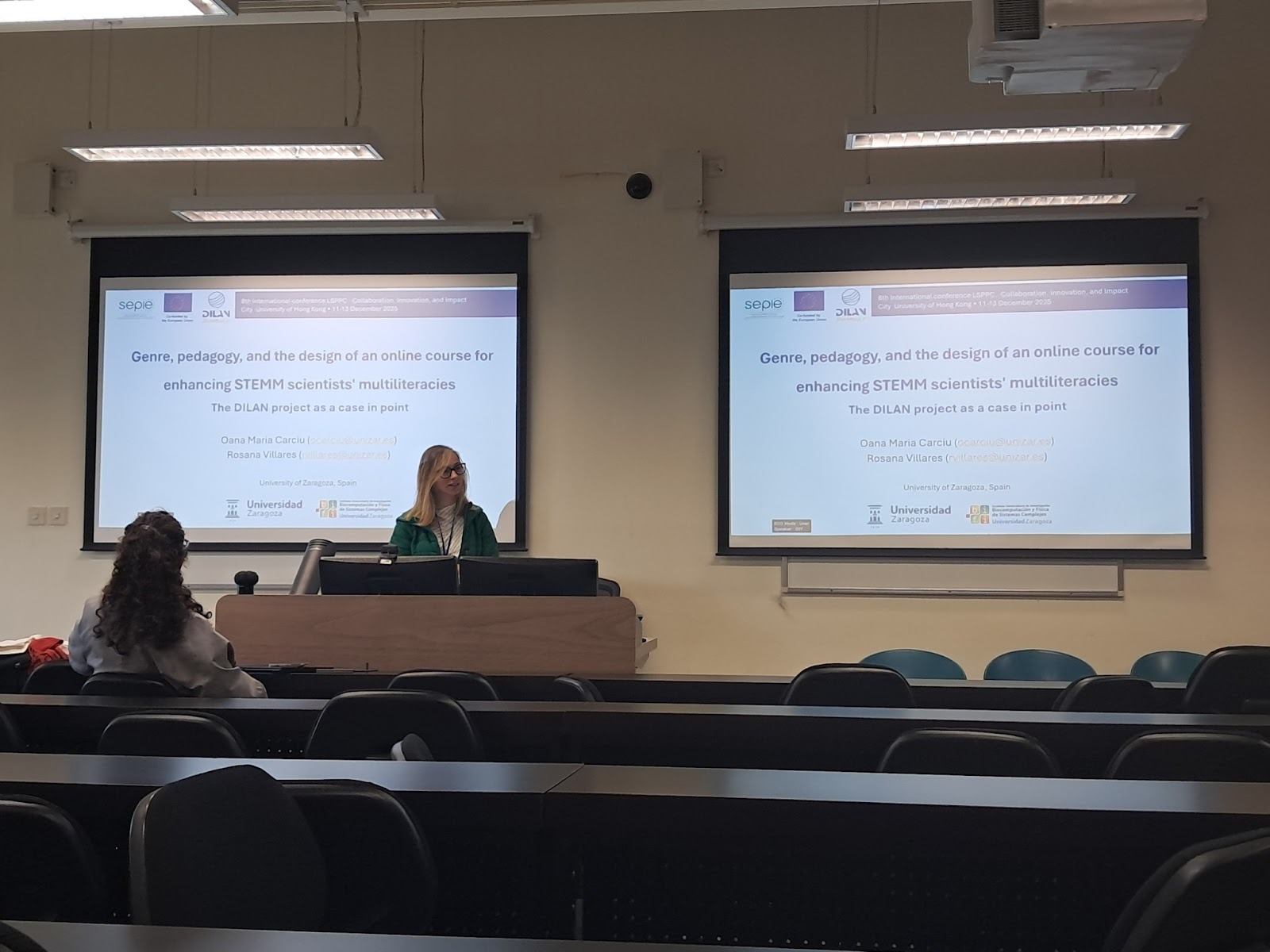
Digital transformation and Open Science have pushed us once again to reexamine our approach to genre pedagogy in LSP and professional communication. In the quest to expand genre pedagogy didactic practices, LSP practitioners need to address current shifts in communication practices triggered by emerging digital semiotic technologies to be able to train future professionals to communicate using a repertoire of digital genres for public engagement and communication to diverse audiences online (Belcher 2017; Pérez-Llantada 2021). This study aims to show how we approached this challenge by assessing the design of a pilot online training course that aimed to expand and refine STEMM women scientists’ academic and professional communication literacies for participation within online specialized and non-specialized communities. A series of data considered relevant to the assessment of the pilot course design were collected: learning resources, course structure, data generated by the interaction of the course participants and instructors with the platform. Qualitative content analysis using Atlas.ti v. 25 was conducted to assess the alignment of the course with genre pedagogy principles and identify new didactic practices. In addition, the findings of the qualitative content analysis of the pilot course were corroborated with semi-structured interviews with the instructors and course designers. Preliminary findings indicate that the course provided students with knowledge of emerging digital genres, interdiscursivity and practice in genre knowledge transfer for continuous development of digital text composing and communication skills for engaging specialized and non-specialized online audiences. There was also evidence of the inclusion of rich input and practice on strategies of scientific content recontextualisation, language mediation and multimodality (including resemiotization of content from verbal to visual). We conclude with a reflection on learning, teaching, and assessment using genre pedagogy in LSP and professional communication in the context of digital transformation, artificial intelligence and Open Science.
Learning digital genres for science recontextualization and resemiotization (https://doi.org/10.5281/zenodo.17985340)
The Open Science agenda has fostered new communicative practices among scientists to make science transparent, collaborative and accessible so that lay publics can actively engage with scientific knowledge (Bartling & Friesike, 2014). However, this social demand has brought inherent challenges for scientists, who must develop transversal skills, and learn how to adapt their discourse and accommodate science to diversified audiences (Pérez-Llantada & Luzón, 2022; Wickman & Fitzgerald, 2019). Within this context, we designed a doctoral training course on soft skills and digital genres used to communicate specialized knowledge to multiple audiences on the Internet. In this presentation we analyse the set of digital genres produced by the doctoral students -a data article, a narrative CV, an impact statement, a lay summary, an academic website, an infographic and a video presentation- in order to identify genre knowledge transfer, recontextualization and resemiotization strategies (Kang, 2022; Miller, 2016; Salö & Hanell, 2014; Xia, 2023). The student-produced set texts were analysed combining corpus-based techniques to analyse linguistic data (e.g., frequencies, n-grams, collocations) with qualitative manual analysis to code recontextualization strategies and the multimodal features employed in their digital texts. Lancsbox v10 was used to extract the linguistic data, while the qualitative content analysis was carried out with Atlas.ti v.25. Preliminary results show a high level of interdiscursivity and genre knowledge transfer within the genres sharing communicative purposes (e.g., promotional genres such as the impact statement and lay summary, or genres that grant authorial credibility such as the narrative cv and the academic website). Regarding qualitative data, students relied on recontextualization (i.e., plain language, explicitations, definitions) and resemiotization strategies among the different genres to ensure their message was conveyed successfully in different modes (textual, visual, and oral). We conclude that raising genre and audience awareness is an essential part of scientists’ communicative Open Science practices that should be encouraged and trained.