Our colleagues Gonzalo Ruiz, from Kampal Data Solutions, Jose Divasón from Universidad de la Rioja and Carmen Pérez-Llantada from University of Zaragoza presented DILAN-based interdisciplinary research in the 13th International conference Synergies in Communication, held in Bucharest, Romania (30-31st October 2025). This research addresses a gap in scientometrics by combining quantitative network analysis with qualitative linguistic analysis to interpret academic success.
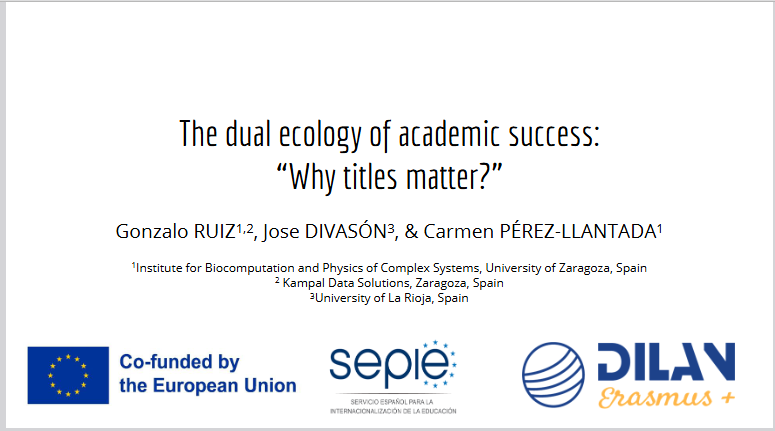
One of the most persistent challenges in understanding global research communication is the failure of most scientometric studies to systematically combine quantitative insights with the in-depth qualitative linguistic analysis required to interpret communication effectiveness. This article addresses this methodological gap by presenting a mixed-methods framework that simultaneously examines the structural success of researchers’ collaborative ecosystems and the communicative efficiency of their published output titles. We generated co-authorship networks for four highly successful researchers in STEM fields, utilizing established bibliometric algorithms on extensive publication data, co-author linkages, and institutional affiliations. The resulting networks were analyzed via a range of network metrics and community detection algorithms to identify distinctive structural characteristics, key influential nodes, and the overall significance of these collaborative structures within the academic community. Critically, this quantitative network analysis is robustly complemented by linguistic data mining applied to the titles of the articles forming these networks. This goes well beyond simple metrics to generate sophisticated measures of lexical and syntactic complexity. Our analysis profiles the titles using a specialized set of metrics relevant to corpus linguistics, including measures of lexical and syntactic complexity. Our main aim was to formally quantify the titles’ communicative efficiency—a critical factor in driving readership and initial research impact. The study’s main contribution is its combination of these two domains. In this presentation we explore the direct associations between these identified linguistic features and the articles’ bibliometric scores (e.g., citation performance). The resulting data offers novel insights not just for research design, but also for informing English for Academic Purposes (EAP) curricula. Specifically, the findings provide data-driven strategies for training researchers in strategically building effective collaborative ecosystems and, crucially, mastering the linguistic demands of high-stakes academic discourse, ultimately helping them maximize their visibility and research impact.