
Our colleagues Oana Carciu and Rosana Villares co-edited the volume “Digital Genres for Academic and Professional Communication” (2026), Routledge, with 13 relevant contributions to map practice and research in the LSP world.
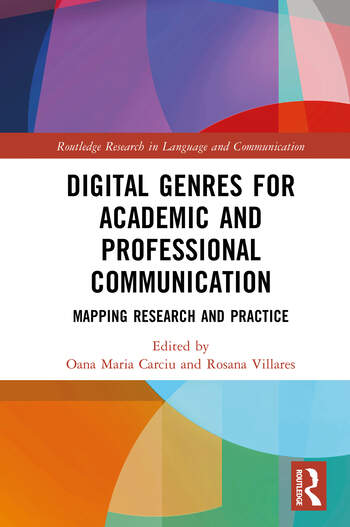
This edited volume represents a collection of empirical research on essential topics in ESP, advancing our understanding of digital genres in a cohesive manner.
It contains 13 original contributions that offer wide coverage of the most influential theoretical frameworks and methodological advances in researching and teaching digital genres in academic and professional contexts. The chapters are authored by specialists from diverse fields, including corpus linguistics, genre analysis, critical discourse analysis, social semiotics, and ESP pedagogy. The volume comprehensively covers both academic and professional digital genres, ranging from research results announcements, video abstracts, video highlights, digital posters or Open Access dissertations to blogs, tourism websites, online annual reports, digital manuals for aviation, and online doctor–patient consultations. Fostering engaging discussions, some chapters examine digital genres in contrast to traditional ones, while others provide a cross-linguistic perspective. Evidence is derived from the application of multiple interdisciplinary perspectives and methods (qualitative and quantitative). Innovative pedagogical approaches to teaching digital genres, such as collaboration between practitioners, or collaborative learning are also illustrated.
The primary audience for this book comprises ESP researchers, scholars, instructors, teacher trainers, and language educators involved in preparing future citizens for academic and professional communication in a digital world.
Table of Contents:
Part I Theorising digital genres
Chapter 1. Digital genres in ESP: Theoretical and practical issues. Oana Maria Carciu and Rosana Villares
Chapter 2. Exploring digital genre analysis in LSP: A key thematic lemma-based approach. Alejandro Curado Fuentes
Part II Exploring digital genres in academic contexts
Chapter 3. Research results announcements online: Actors and genres in the processes of parallel knowledge entextualisation. Krystyna Warchał
Chapter 4. Digital journal submission invitations: Multimodality, discourse, and journals’ status. Tatyana Yakhontova
Chapter 5. Comparing the written and the video abstract: The impact of multimodality on metadiscourse choice. Olga Dontcheva-Navratilova
Chapter 6. A corpus-based multimodal analysis of Open Access dissertations: The impact of discipline and language. Flor de Lis González-Mujico and David Lasagabaster
Part III Exploring digital genres in professional contexts
Chapter 7. Digital emergency management posters in the context of pandemic communication. Francisco Miguel Ivorra-Pérez and Rosa Giménez-Moreno
Chapter 8. “Unsure of the next step in care”: A genre analysis of patients’ questions in digital medical consultations. Stevan Mijomanović
Chapter 9. Digital annual reports of financial institutions: An analysis of credibility and persuasion on a global scale. Sophia Kaltenecker
Chapter 10. Framing facilitation and causation in aircraft maintenance manuals: A case study of the A330 manual. Meng Ye, Eric Friginal, Malila Prado, and Daniela Terenzi
Chapter 11. The liminal language of promotion in dark tourism: A corpus-driven critical genre analysis methodology. Marian Alesón-Carbonell
Part IV Pedagogical applications of digital genres
Chapter 12. Fostering multimodal literacy using video highlights: A collaborative approach to pedagogy in EME and ESP settings. Nuria Edo-Marzá and Vicent Beltrán-Palanques
Chapter 13. From brochures to blogs: Opportunities and challenges in implementing a digital genre in English for tourism. Balbina Moncada-Comas and Irati Diert-Boté